
When brands compare calculate landed cost for packaging quotes, the first number they see is usually the pouch unit price. But for importers, distributors and brand owners, the real decision should be based on landed cost, not factory price alone.
Landed cost shows how much each pouch truly costs once it reaches your warehouse. It includes manufacturing, freight, duties, taxes, insurance, handling and quality control. For flexible packaging supplier projects, understanding this full picture helps buyers avoid margin surprises and make better sourcing decisions.
What Is Landed Cost for Custom Pouches?
Landed cost is the total cost of getting packaging from the factory floor to your warehouse door. It is not the same as the supplier’s FOB or EXW price.
A basic landed cost formula looks like this:
Landed Cost = Product Cost + Freight + Insurance + Duties + Taxes + Customs Fees + Handling + Overhead
For custom pouch pricing breakdown, the calculation should include:
- pouch unit price and tooling costs
- international freight and fuel surcharges
- cargo insurance
- import duties and VAT or GST
- customs brokerage and port charges
- inland transport to your warehouse
- quality inspection and compliance costs
- currency conversion and payment fees
For example, a pouch quoted at $0.35 per unit may land at $0.48–$0.55 after freight, duties and local charges. That difference matters when you plan retail pricing, wholesale margins and reorder volumes.
Break Down the Real Cost Components
Product Cost
This is the factory price for the pouches. For custom packaging, it usually includes material structure, printing cylinders or digital setup, bag-making labor, zippers or valves, and packaging for export.
Ask suppliers to clarify:
- Is the price EXW, FOB or CIF?
- Are cylinder fees included for rotogravure printing?
- Is digital printing charged per unit or per batch?
- Are samples, testing and export documentation included?
A packaging factory direct quote should be transparent. If a supplier cannot explain what is included, the final cost may change later.
Freight and Shipping Costs
Freight and shipping costs packaging depend on weight, volume, Incoterms and destination. Flexible pouches are relatively lightweight, but they still occupy container or pallet space.
Key freight items include:
- ocean or air freight charges
- origin port handling
- destination port charges
- inland trucking
- fuel surcharges
- demurrage or detention if clearance is delayed
For buyers in France, the UK, Canada, Brazil or the UAE, freight strategy should match order size. Full container loads usually reduce per-unit cost, while air freight may be justified for urgent launches or small test batches.
Duties, Taxes and Customs Fees
Import duties are based on the product’s HS code, country of origin and destination rules. Taxes may include VAT, GST or other local charges. Customs brokers may also charge handling fees.
Regional considerations include:
- packaging import duties France and EU customs rules
- packaging import duties UK and VAT treatment
- packaging import duties Canada and CARM-related clearance requirements
- packaging import duties Brazil and local import complexity
- packaging import duties UAE and free-zone options
HS code classification should be confirmed with a customs broker before placing an order. The correct code affects duty rate, VAT base and clearance speed.
Insurance, Quality Control and Overhead
Many buyers underestimate risk and administrative costs. A realistic B2B packaging cost guide should include:
- cargo insurance
- third-party inspection fees
- pre-shipment inspection
- bank charges and payment fees
- currency exchange impact
- warehouse receiving costs
These items are small individually, but they add up across multiple shipments.
Compare Factory Price With Total Cost of Ownership
Unit price is only one part of total cost of ownership packaging. A slightly higher factory price can still deliver a lower landed cost if it reduces waste, delays or quality failures.
Consider these factors:
- Custom packaging MOQ and pricing: Lower MOQs may increase unit cost but reduce inventory risk.
- Packaging inventory carrying costs: Large orders save on unit price but tie up cash and warehouse space.
- Cost per unit packaging wholesale: Allocate freight and duties by volume or value, not just by unit count.
- Hidden packaging sourcing costs: Poor seal strength, wrong dimensions or delayed shipments can create larger losses than a small price difference.
For flexible packaging, pouch design also affects logistics. Flat pouches or roll stock film may ship more efficiently than pre-formed bags with bulky cartons. A reliable supplier should help optimize carton size, pallet loading and container utilization.
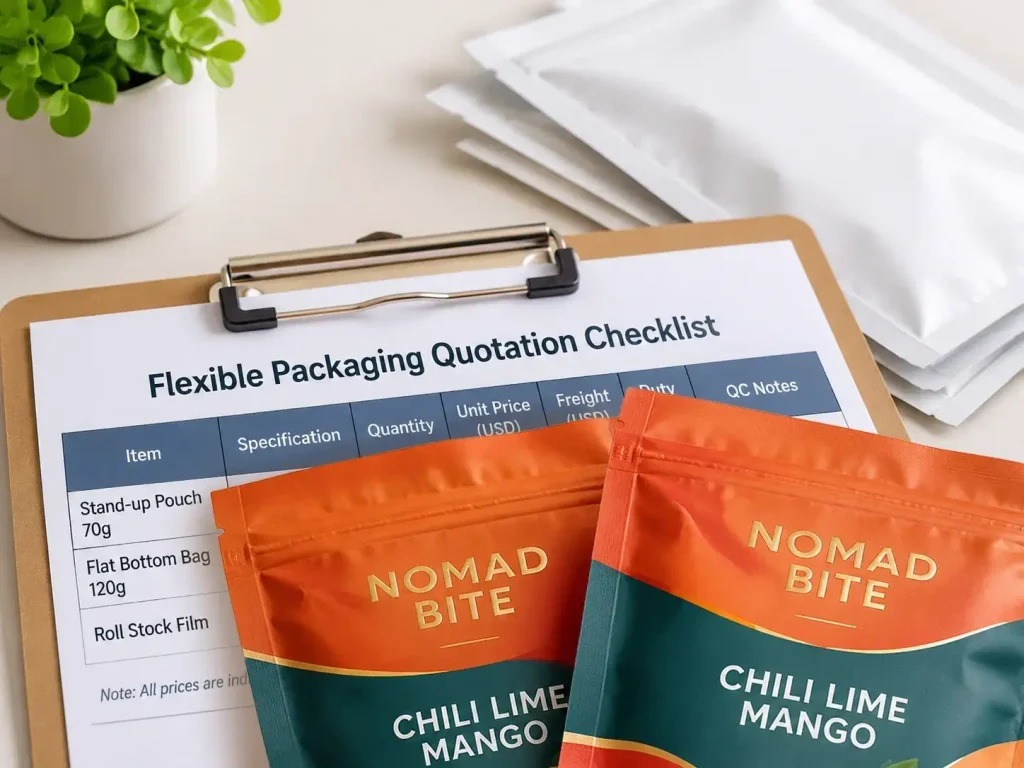
Use a Simple Landed Cost Checklist for Custom Pouches
Before approving a quote, run it through this checklist:
- Confirm Incoterms: EXW, FOB, CIF or DDP.
- Request an itemized quotation.
- Confirm HS code with your customs broker.
- Estimate duties, VAT or GST for your market.
- Get at least two freight quotes.
- Add insurance at 0.3–0.5 percent of shipment value.
- Include customs brokerage and port fees.
- Add inland transport to your warehouse.
- Allocate costs by SKU if the shipment includes mixed products.
- Calculate final landed cost per unit.
This process works for snack stand up pouch, coffee packaging, pet food pouches, flat bottom bags, roll stock film and recyclable pouch projects.
Why LuckeePak Helps Buyers Reduce Packaging Risk
LuckeePak is a China-based flexible packaging factory supporting coffee brands, snack brands, pet food brands, food manufacturers and packaging distributors. We combine factory production with professional export service, so buyers get clearer pricing and smoother international delivery.
Our advantages include:
- custom flexible packaging manufacturer capability
- packaging factory direct communication and pricing
- FDA/BRC-supported compliance framework
- digital printing for short runs and faster market testing
- stand up pouch, flat bottom bag, roll stock film and retort pouch production
- recyclable and sustainable packaging options
- professional export documentation support
For buyers evaluating a flexible packaging supplier, LuckeePak helps move from unit price to full landed cost planning. This reduces uncertainty and makes cross-border packaging procurement more predictable.
Conclusion
The true cost of custom pouches is not just the factory quote. It includes freight, duties, taxes, insurance, handling, quality control and inventory costs. Brands that calculate landed cost for packaging before placing orders can protect margins, avoid customs surprises and choose suppliers with confidence.
Whether you need snack packaging for Europe, snack packaging for France, snack packaging for UK, snack packaging for Canada, snack packaging for Brazil or snack packaging for UAE, LuckeePak supports buyers with transparent quotations, compliant materials and export-ready flexible packaging.
FAQ
1. What is the difference between unit price and landed cost?
Unit price is what you pay the supplier for the pouches. Landed cost includes unit price plus freight, insurance, duties, taxes, customs fees and local handling until the goods reach your warehouse.
2. How do I calculate landed cost per pouch?
Add product cost, freight, insurance, duties, taxes, customs fees and overhead, then divide the total by the number of pouches in the shipment.
3. Which HS code should I use for flexible packaging pouches?
HS codes depend on material composition and product use. You should confirm the correct code with your customs broker or importer before shipping.
4. Does LuckeePak support small orders and digital printing?
Yes. LuckeePak offers digital printing packaging and custom flexible pouches for brands that need shorter runs, faster sampling or multi-market artwork updates.
5. Can LuckeePak ship to France, the UK, Canada, Brazil and the UAE?
Yes. We provide export-ready flexible packaging and professional documentation support. Final duties, taxes and clearance responsibilities should be confirmed with your local customs broker.